
As promised, here is an experiment that grew from a conversation I had with one of the employees/Plant Wizards of Pesche's greenhouse.
The problem: I recently acquired a Cyathea cooperi (Australian tree fern) in a ten inch pot. I will be attempting to keep it alive indoors this winter. Internet research has yielded unto me that Cyatheas are very heavy feeders, often receiving monthly emulsions of things like blood and bone meal when grown outdoors in warm climates. Being a prehistoric plant covered in sharp scales and feasting on blood and bones, Boyfriend settled on a name for our tree fern: Clever Girl.

But what to feed Clever Girl? I refuse to pour out repugnant, smelly emulsions in my apartment. And being in a pot, the concentration and administration of said grossness would need to be adjusted. Also, pot culture also lacks a much of the soil bacteria that tree ferns enjoy, and how would I account for that with fertilizer? The good folks at Pesche's had an interesting suggestion: Espoma's Biotone.

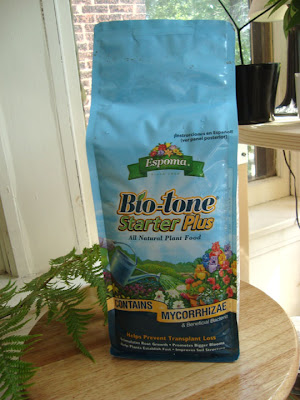
Biotone is a fertilizer medium that helps transplants survive. It contains small amounts of all the aforementioned gross things, including the bacteria. Now, I couldn't figure out exactly what kinds of bacteria tree ferns need, so this could be as pointless as fertilizing with Brawndo, the Thirst Mutilator (it's got what ferns crave! bacteria!). Nevertheless, Plant Wizard seemed pretty confident about it, and I trust him. I have never used this product before, and so I am not endorsing it in any way. Yet.
 Here's what it looks like. It stinks a wee bit.
 Plant Wizard and I also realized that, being a fertilizer medium, Biotone could be applied as a top-dressing. Now we're back to the fun stuff.
LADY, WHAT IS TOP-DRESSING? WHY DO I CARE?
Top dressing is a technique used to deliver fresh, un-compacted, nutrient-rich soil to plants that are too big and heavy to repot. You should care because you've probably got some miserable dracaenas laying around the home or office, in huge pots, that haven't had a soil change in fifty years. You make me sick.
Here's how to top-dress!
Step 1: Assemble your tools. You will need a toothpick or skewer, a disposable spoon, an empty container, and (depending on the size of the plant) several cups of your medium-of-choice. I used about 1 1/2 cups of Biotone, as per package directions.
Step 2: Using your spoon, scrape the first couple of inches of topsoil off your plant. Don't break up any roots, if you can help it. Dump the loose soil into the container.

scrape scrape
Step 3: Check the loosened soil and the exposed soil surface of your plant. Bugs? Fungus? Bad smells?

Step 4: Take your skewer and give the exposed soil a good stabbos. This will aerate the old, compacted soil.
Step 5: Pour on your potting medium and spread it out evenly. Make sure you're not burying any stems, vines, or new growth, and never bury the crown of ferns or rosette-forming plants.

Lovely! Top-dressing accomplished. You can top-dress your behemoth potted specimens every spring as a substitute for potting-up, and you might consider simply repotting if you can lift them. Technically, repotting is different from potting-up in that it constitutes pruning the roots, changing the soil, and then putting the plant back into a container of the original size. Repotting is ideal for plants that we intend to grow slowly or plants whose size we intend to control (i.e. bonsai and large indoor plants). Potting-up means placing a plant into a larger container where it will have room to grow larger. For the purposes of this blog, however, I often use "repotting" to mean repotting and potting-on, because I am reproachably lazy.
Anyway. Updates on Clever Girl will be provided.
*Jurassic Park photo: http://thepensblog.blogspot.com/


