Showing posts with label Nephrolepis. Show all posts

6.10.2010

just some plants i am growing


i am going to do some how-to posts very soon. but for now...


1. sansevieria trifasciata
2. peperomia argyriea, post-division
3. microsorum thailandicum and schefflera
4. more p. argyreia (post division, after all)
5. abutilon hybrid
6. strelitzia (nicholai or reginae?)
7. senecio macroglossus
8. aloes and agaves
9. cotyledon tomentosa
10. nephrolepis 'emina'
11. phalaenopsis 'balinese splendor'
12. sansevieria 'crazy-ass fool' (i can't figure out which
 cultivar this is)
13. fatshedera lizei

3.29.2010

In Memoriam III


Dearly beloved. We are gathered here to honor the memory of my latest assassinations. Take comfort in the knowledge that, in death, they serve a greater purpose... making room for more plants.


Roll call!


Adenium obesum - incurable and debilitating case of the uglies; also mealybugs


Nephrolepis exaltata - scale


Ficus pumila - mealy bugs


Schlumbergera NOID - ritual seppuku


Leptinella squalida - root nematodes


Plumera rubra - mauled to death


Microsorum diversifolium - scale


Jasminum sambac 'Belle of India' - thirst. This cultivar should really be called 'Candyass of India,' or perhaps 'Viola,' because it's a pansy. Yeah, that's right, I killed you and I'm NOT sorry. You were not well-suited to indoor culture. In fact, as a species, you Jasminums need to get your shit together! Until then, friendship cancelled.


 If you would like to express your condolences, feel free to send me more plants. I'll be out, grieving. And shopping. For plants.


10.27.2009

The Greater Good!


Problems happen with our houseplants. You know, it, I know it. This time of year, when we're dealing with issues of humidity, temperature, pests, etc., we have to think about optimizing our conditions, getting creative with our solutions, and cutting our losses. Got any maidenhair ferns? Got central heat? Then I've got news... your fern is as good as dead. Don't freak out! Maybe you can find a cloche or a suitable terrarium. Maybe you can give them away. Or, if you're me, maybe you can throw those fuckers out and find a fern that is more compatible with your indoor habitat. When a threat, sickness, or general weakness is detected, it pays to consider The Greater Good. Here's a few of my current problem plants.


Epipremnum aureum "Marble Queen," suffering shock from change of temperature and light. If you keep pothos outside during the summer, like I do, you can expect to see some leaf shed as they re-adjust to indoor conditions. It's normal. Yellow leaves will not recover and also invite pests; trim them. THE GREATER GOOD!


Phototropism in a N. exaltata "Emina." This results from low light levels or single-direction light. Moving the plant closer to a window or simply rotating the pot every week should solve this problem.


Musa acuminata "Novak." Dead lower growth likely due to cold draught exposure and dry air.


Citrus meyeri suffering from underwatering. Well, not so much "suffering from" as "dead from." I've already thrown them away. THE GREATER GOOD!

Defolation in Adenium obesum due to cold exposure and transplant shock; A. obesums occasionally go dormant in the winter when conditions fluctuate. Don't panic if you lose all your leaves... hold back on the watering and wait for spring.


5.14.2009

Full Scale Attack


Scale insects. First you see one, then two, and then the picnic's ruined. Yes, these bitches are the Knights of Byzantium of a Nature Slayer's world. I've tried washing, scrubbing, picking, and poisoning scale insects, but in the end they always win. The have a guerrilla strategy wherein they breed in mass numbers and hide in plain sight, tiny and unnoticeable. Then overnight they develop into terrifying, fully armored monstrosities.

hemiptera diaspididae: a common household pest*


Just this morning, I surrendered two precious territories to the scale invasion. Both will be missed, as both of these were ferns that moved here with me from St. Louis. This leaves only six of the old plant crew, which used to roll about thirty deep. First the scale took my last Asplenium Nidus "Osaka," which was the oldest and loveliest of all. Then they took my Nephrolepis Exaltata "Tiger," which really pissed me off.

This is your fern:


This is your fern with scale:

Any questions?

*image in the public domain

3.28.2009

Bow chicka' bow bow...


Happy spring, my bishes! It's is officially here, and it seems that roughly half of the inhabitants of the household have decided to get busy with the babies. Not the Monsieur or myself, thank you very much. I will casually defenestrate a plant at the first sign of obstinacy, so I shudder to think about what I'd do with a baby. Maybe my plants saw the death strokes that befell the two sickly ferns during the recent repot, and they decided to put on some new growth to please me. This was rather intelligent of them, I think.

Et tu, Nephrolepis?

So here's what we've got. My little tiny Aloe "Dorian Black" now has a pup. "BUT SHE'S SO YOUNG!" I know, I know. I told her the same thing. I can't say I'll be sad to have another one of these, though... I mean look at it! It's stunning, almost completely white.


My Meyer lemon seeds have finally sprouted! Do you see my thrifty invention? I took one of those clear egg cartons and made a little incubator out of it. It's always moist and gets plenty of sun, plus it sits between the window and the radiator, so it never gets chilly. I opened it up for this picture:


The Epipremnum aureum "Marble Queen" immensely enjoyed its repot. I also rooted this winter's cuttings, which are doing fine. It's in a really fast-draining medium of mostly pumice and pine bark fines. Rapidly, it became bushy with new growth.

Here's a better shot of the color. The new leaves are almost completely white, probably because they're getting more sun.


Here's the baby crosiers from my Nephrolepis "Emina." Now in a slightly peat-ier medium.

My teeny-weeny Philodendron "Moonglow" has put on a new leaf after I gave it a much-needed soil change.
The beastly Philo "Black Cardinal" has finally adjusted and is putting out this beautiful new leaf:

Strelitzia Reginae is now completely mealybug-free and putting on tons of new growth after being potted up:

Sansevieria "Bally" has made a baby offshoot:

And as usual the cats are all up on it. We keep telling them that they are both fixed, and will never consummate their love, but do they care? No, they just continue making out on the couch when we have friends over, which is awkward for everyone. 

K thx bai

3.20.2009

In Memoriam

As a practicing nature assassin, I try not to get too emotionally involved with my targets. However, I feel it is only fair that I commemorate some of those houseplants that put up bold struggles before hitting the landfill. To the friends and families of these specimens I offer my condolences... believe me when I say that I am trying to quit. I just can't help that I'm good at what I do.

The following plants were excommunicated, and hopefully are living well with their new craigslist families.

Variety and Sin:
Philodendron "Xanadu" - scale insects
Ficus elastica - scale insects
Dracaena Warneckii - extreme deliciousness towards felines
Cycas revoluta - too angsty

Crassula Ovata - too vain


Successful Assassinations of 2008:

Variety and Cause of Death
Hedera helix variegata - spider mites
Rosemarinus officinalus - suicide
Ficus microcarpa "Green Island" - cat attack
RIP

Successful Assassinations of 2009 (so far):


Asplenium nidus "Osaka" - fungus gnats
Arachnoides simplicior - thirst
Chamaedorea elegans - cat attack
Neprolepsis exaltata "Suzi Wong" - root rot
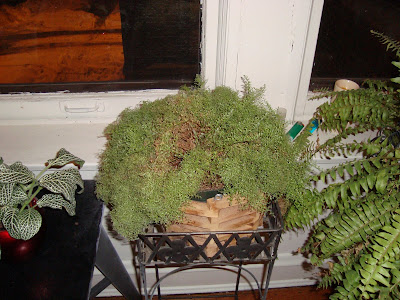
Cupressus macrocarpa "Wilma" - shame

Congratulations to my Norfolk Island Pine, who is now the longest surviving member of the team! Keep up the good work, Araucaria heterophylla, and you just might be spared from next week's scheduled abusive overfertilizing!

3.07.2009

New growth for the new season


I've never been great with sitting meditation, but I imagine that the deep feelings of calm and well-being that come from working with plants must be an equivalent exercise. This week I found time to do one of my favorite chores: a deep cleaning of my plant room. I try to do this once a month, all the while practicing deep breathing and compassionate thinking. 

Occasionally, compassionate thinking is really aided by drinking chocolate milk and reading lolcats, but I'm not sure if that is as "spiritual" of an endeavor. Anyway. 

First I remove all the plants from my sun room and put all the cachepots and trays in the kitchen. Then I clean the room thoroughly, including my three humidifiers and my gardening/bonsai tools. Next, I take all of the pots and trays and scrub them down in hot, hot water. The pebbles from my humidity/drip trays get rinsed in a colander. I love observing what gets built up in a month, because it tells me so much about the plants. For example, my super dwarf banana had some small crawling insects in its tray, which means it probably needs its soil changed very soon (I neglected to change the soil when I brought it home from a commercial greenhouse, which is sort of a no-no).

Finally, I spend time with each of my plants. In bright light, I check the leaves, fronds, inflorescences and what have you, the soil, and the roots. I trim back dead growth when it is appropriate, and I made notes in my garden book concerning the future needs of each plant. I sometimes take photographs as well, to document improvement or decline. The close contact is good for both of us, I like to think... I enjoy their various smells, colors, and intricacies, and presumably they appreciate my CO2. When I'm finished cataloguing everything, the plants are all arranged back in the sun room according to their light preferences. 

Obsessive? Perhaps. Now you may be thinking, the chocolate milk and lolcats would be healthier than this.

Well, what did I observe that was particular interest? First off, my dracaena massangea is on its last leg, but I don't feel like getting into that now. If it can survive until spring, when a repotting is in order, this plant will be fine. Otherwise, it's the dumpster for this puppy.

Speaking of which, my Aloe "Parvula Jacobsonii" has pupped! I'm fairly surprised, given the condition this plant is in. I bought it at half price because it had been tucked away and forgotten at the greenhouse, and consequently most of the lobes (what is the term for an aloe "leaf," anyway?) had dried up and snapped off. I couldn't pass it up because I love the powdery blue color it acquires with age. Here is a photo of the pup, which I hope to separate in a few months:
Here is the other good news. In early December, I visited the superb family-owned greenhouse "Ahners" in St. Louis. I brought home a variety of nephrolepis colloquially known as "Jester's Hat" or "Curly Boston." Unlike the average Boston fern, this ("emina") has a completely upright habit with tight curls. Here is a healthy example from Dave's Garden.

I have not been able to find much info on this fern, except that they are somewhat difficult to satisfy and grow very slowly. I would agree with both of these points. Mid January, in a fit of pique, my fern almost completely shed its leaflets, leaving it a bundle of sticks. I was disappointed, but I learned my lesson about letting these guys dry out for even a short time. Since then, I have patiently and conscientiously watered and waited. When I was cleaning this week, I noticed four new crosiers popping up! Not only this, but when I checked the root system, look was was going on below the surface:
Look at all those little guys making their way up! Hooray! So here's a question for the fern pros... would you say this could use a potting up, come spring? It's currently in a 4-incher, but it looks to me as through the rhizome is pushing for more room. Any thoughts?

Enjoy the warm weather and the rain!